
The coffee maker, toaster and blender may be useful every day, but together they can take over a kitchen counter. Putting everything away after each use sounds reasonable—until you have to lift the same appliances in and out of a cabinet every morning.
An appliance garage offers a middle ground. It keeps small appliances close to the work area while hiding them behind a cabinet door when they are not in use.
It can be especially appealing in a compact NYC kitchen, where clear counter space is valuable. But an appliance garage also takes up room of its own, so the design needs to solve more problems than it creates.
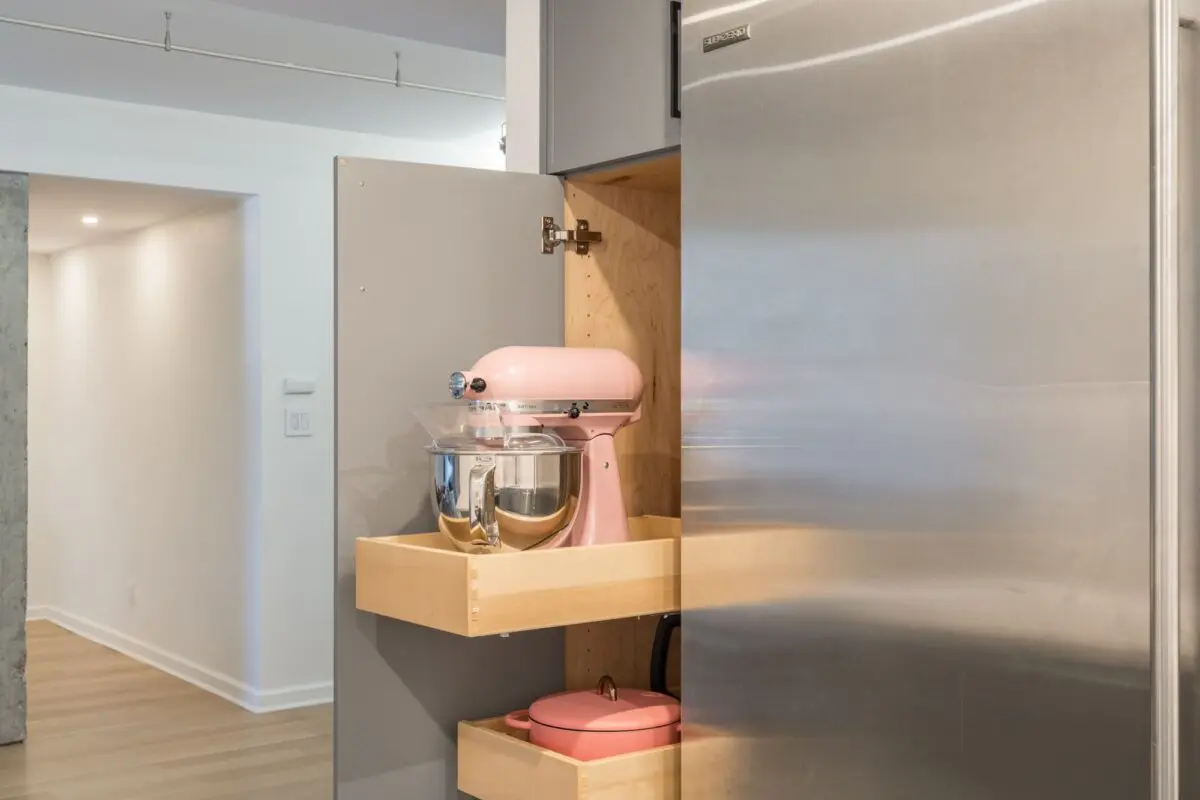
What Is an Appliance Garage?
An appliance garage is a cabinet or enclosed section of countertop designed to store small kitchen appliances.
Unlike a regular upper cabinet, it usually begins at counter level. Open the door and the appliance is ready to use or easy to pull forward. Close it, and the kitchen looks calmer and less cluttered.
Appliance garages can be built into a wall of tall cabinets, placed in a corner or incorporated between the countertop and upper cabinetry. Some are designed for one coffee maker. Others create a larger station for several appliances.
The idea is not simply to hide things. It is to keep frequently used items accessible without allowing them to dominate the room.
Which Appliances Can Go Inside?
Coffee makers, toasters, blenders and electric kettles are common choices. A larger appliance garage might hold a stand mixer, food processor or juicer.
Before designing the cabinet, make a realistic list of what you use. Measure each appliance with the lid open, attachments installed and cord included. A coffee maker may fit inside the opening but still need extra height to refill its water reservoir.
Think about where each item will be used as well. Some appliances can remain inside the cabinet during use if the design and manufacturer’s instructions allow it. Others may need to be pulled onto the open counter.
The cabinet should be planned around your actual appliances—not around a perfectly styled photograph with nothing plugged in.
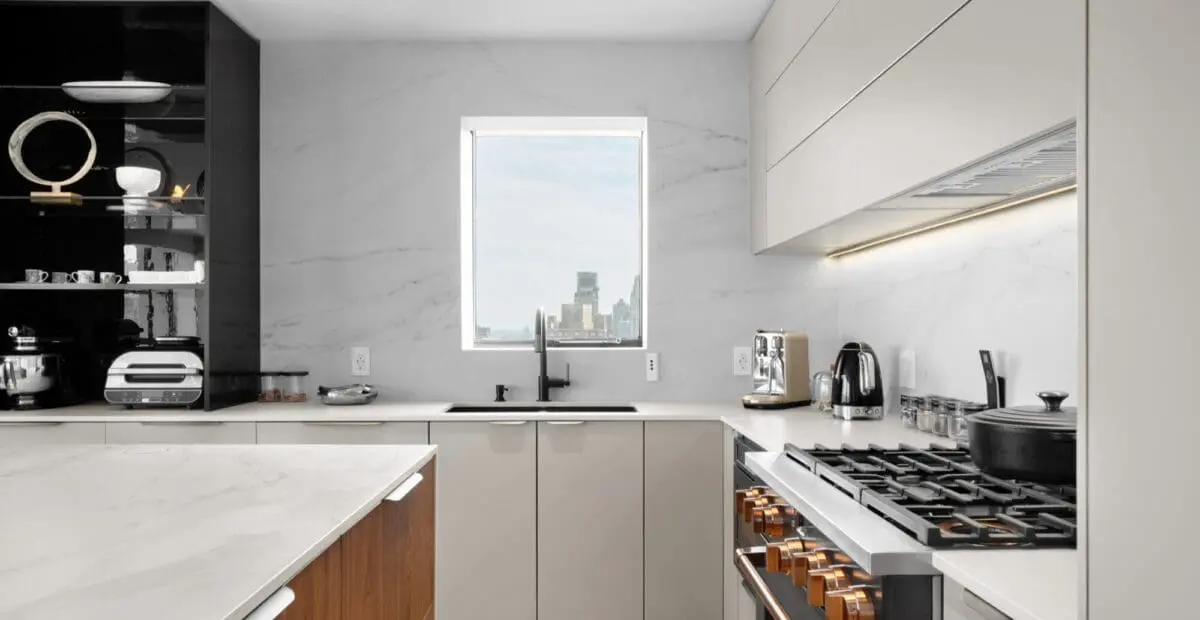
Does an Appliance Garage Save Counter Space?
Visually, yes. Functionally, it depends on the design.
An appliance garage clears the main sightline and groups several small items into one defined area. That can make the entire kitchen feel more orderly.
However, the cabinet still occupies part of the countertop. If it is placed in the middle of an important preparation area, you may gain a cleaner appearance while losing valuable workspace.
Location makes the difference. A garage positioned at the end of a cabinet run or beside a tall cabinet may use an awkward section of counter efficiently. One placed between the sink and range could interrupt the kitchen’s most useful work zone.
In a small NYC kitchen, every inch should earn its place. The appliance garage should make the daily routine easier—not simply make the room look cleaner when nobody is using it.
Which Door Style Works Best?
The door is one of the most important decisions because it affects both access and appearance.
A lift-up door moves above the opening and stays out of the way while the appliance is being used. A retractable door slides back into the cabinet, preserving a clean look without projecting into the kitchen. Pocket doors can open to the sides and disappear into the cabinet structure.
Tambour doors, which roll upward in narrow sections, have long been associated with appliance garages. They can work well where clearance is limited, although their appearance is more distinctive.
Standard hinged doors may be appropriate for a larger coffee station or pantry cabinet, but they require room to remain open without blocking a walkway or adjacent cabinet.
The best option depends on the cabinet width, ceiling height and space in front of the opening. Try to imagine making coffee or toast with the door open. If it will constantly be in the way, the design needs another approach.
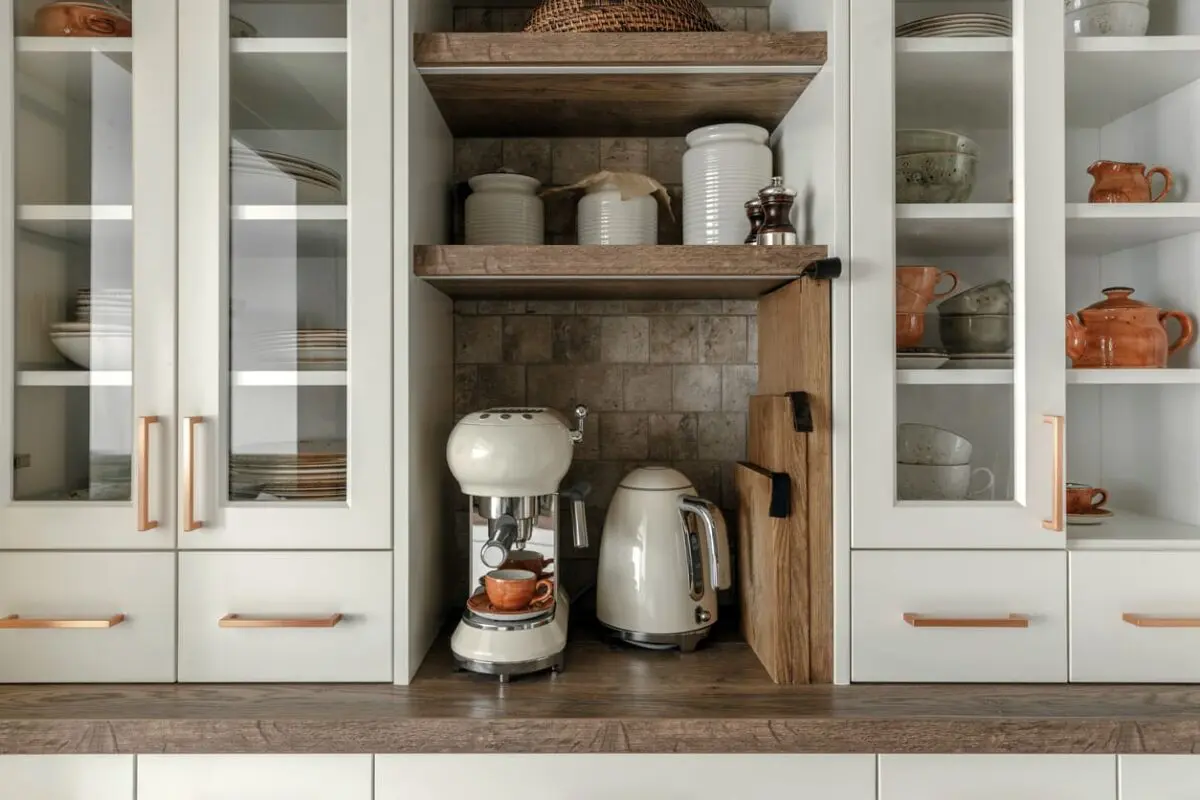
Modern Japandi kitchen interior design appartment in earth tones, natural textures with wooden solid oak furniture and sliding Japanese wood doors. Japandi concept
Should an Appliance Garage Have Outlets?
If appliances will be used inside or immediately in front of the cabinet, electrical planning should happen before the cabinetry is built.
The outlet should be accessible and positioned so cords do not become pinched by doors, shelves or moving hardware. The required electrical capacity will depend on the appliances being used.
Avoid assuming that an extension cord or power strip can solve the issue later. A clean built-in design should include a safe, properly planned electrical connection.
In New York City, new or modified electrical wiring must be handled according to city requirements. The NYC Department of Buildings’ electrical guidance explains that most electrical work requires a permit and must be performed by a licensed electrical contractor.
Electrical placement should therefore be coordinated with the cabinet design during the renovation—not after the appliance garage has been installed.
What About Heat, Steam and Ventilation?
Small appliances can produce heat, steam or both. A toaster behaves differently from a coffee maker, and a countertop oven has different requirements from a blender.
Check the appliance manufacturer’s instructions for ventilation and clearance requirements. Do not assume that every appliance can operate safely inside a closed or partially enclosed cabinet.
A pull-out shelf may allow an appliance to move forward during use. In other situations, the door may need to remain fully open. Some heat-producing appliances may be better stored in the garage but operated on the open counter.
This is another reason to select the appliances before finalizing the cabinet dimensions. The design needs to accommodate how the equipment is actually used.
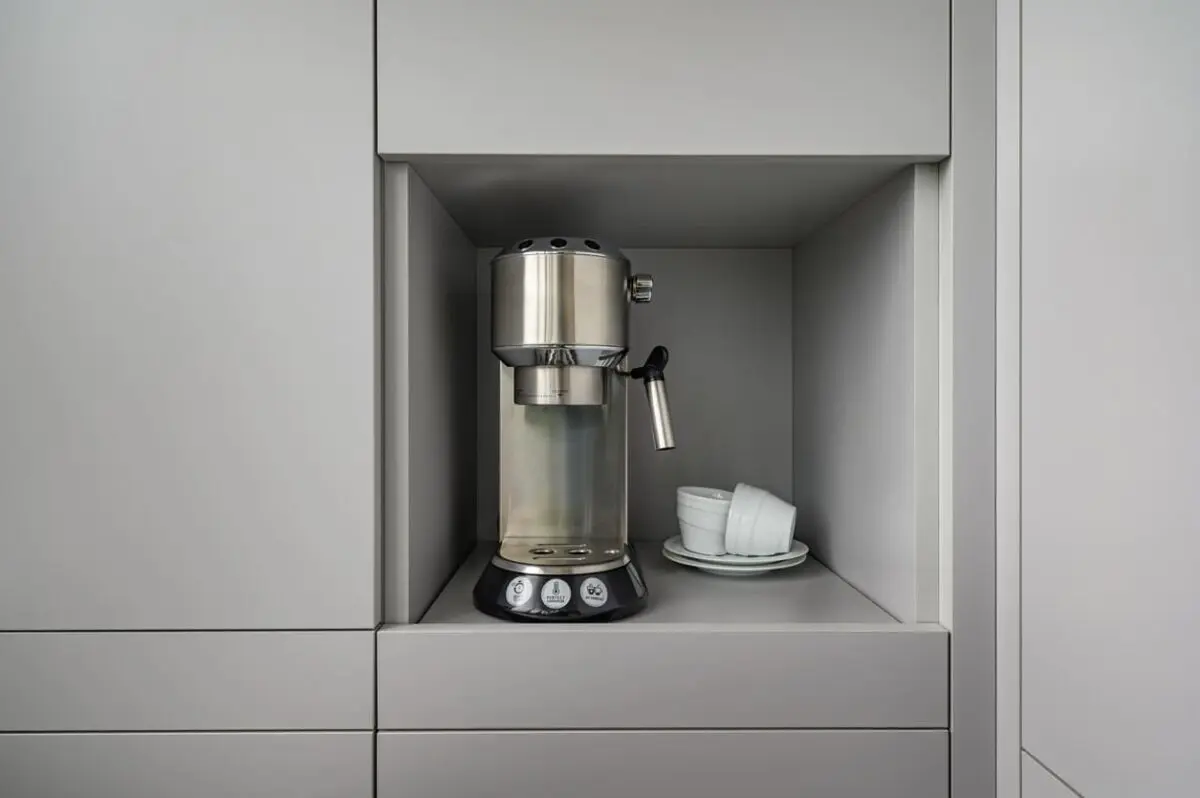
Can It Become a Coffee Station?
An appliance garage can make an excellent coffee station, especially when the household uses the same equipment every morning.
The cabinet might hold a coffee maker, grinder, mugs and supplies in one place. Drawers below can store pods, beans, tea or utensils. When everything is behind one door, the kitchen can transition from a busy morning space to a cleaner living area.
That visual change is useful in open-plan NYC apartments, where the kitchen is often visible from the living or dining room.
The station should still be easy to clean. Spills happen, so the interior surface and surrounding countertop should tolerate regular wiping. Shelves should also be positioned so supplies remain easy to reach.
When Is an Appliance Garage a Bad Idea?
An appliance garage may not be worthwhile if it removes your only useful preparation area or creates a deep corner that is difficult to clean.
It can also be unnecessary if you own only one small appliance and do not mind seeing it. In that case, a dedicated drawer or regular cabinet may be simpler.
Be careful not to make the garage too small. An opening designed tightly around today’s coffee maker may become useless when the appliance is replaced with a larger model.
The design should provide some flexibility while still fitting naturally into the cabinetry.
Does an Appliance Garage Add Home Value?
An appliance garage should not be treated as a guaranteed way to raise a property’s value. Its real benefit is that it can improve storage, reduce visual clutter and make the kitchen easier to use.
Those qualities can help a kitchen feel more thoughtful to a future buyer—particularly when the cabinet matches the surrounding design and does not consume essential workspace.
It is one part of a larger renovation strategy. NYKB’s guide to the best renovations to boost your home’s value explores other improvements that can strengthen a home’s function and overall appeal.
Is an Appliance Garage Worth It?
An appliance garage is worth considering if several small appliances live permanently on your counter and you want them close at hand but out of view.
It works best when the location, door style, outlets and appliance clearances are planned together. It is less successful when it is treated as a decorative cabinet without considering how the kitchen is used.
Before adding one, decide which appliances will go inside and where you need open counter space most. If the garage supports that routine, it can be a small feature that makes the entire kitchen feel calmer.
Ready to Create a More Functional Kitchen?
NYKB can help you plan an appliance garage, cabinetry and countertop layout that fits the way you cook and the space available in your NYC kitchen.
Contact NYKB to schedule a complimentary kitchen design consultation.